
Gas lift in context
Gas lift is an artificial-lift method that introduces gas into a production path to reduce the hydrostatic pressure of the fluid column. The lighter column allows available reservoir pressure to move fluids toward the surface.
Conventional installations may operate continuously or intermittently. Their design depends on well conditions, fluid behaviour, available gas, surface facilities and the intended production strategy; there is no single arrangement that fits every well.
What “Golf Gas Lift” means at NAVI-OIL
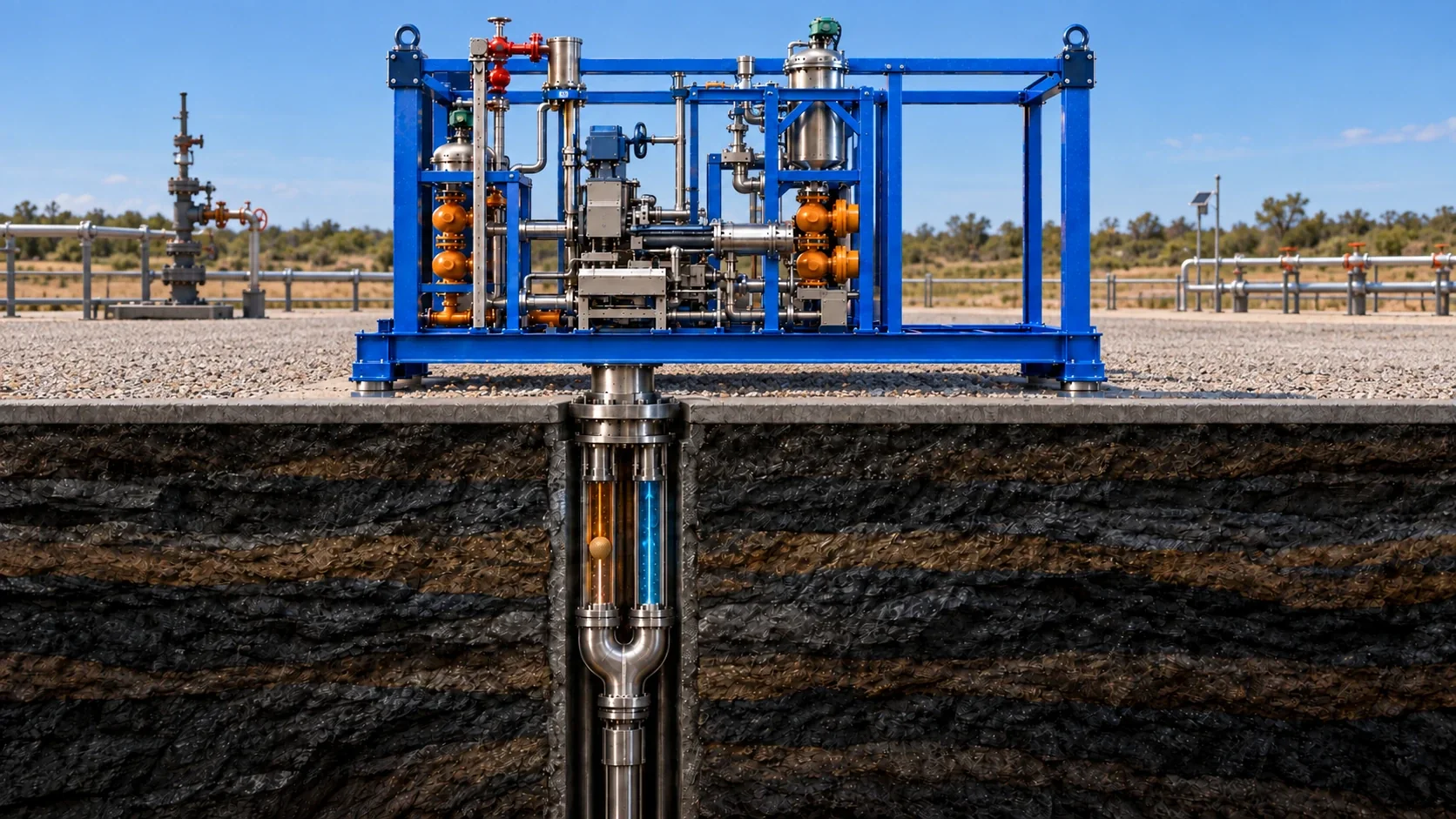
Golf Gas Lift is NAVI-OIL’s name for an integrated artificial-lift direction. It is not presented as a generic industry category. The public system view connects circulating lift elements, instrumented balls and surface instrumentation across one coordinated cycle.
Circulating elements support the physical lift cycle. Instrumented balls record selected downhole conditions. Surface instrumentation connects handling, sensing and control. These are distinct functions that are engineered to work together at system level.
The five public functions in the system view
A useful way to understand the platform is to follow the functions rather than individual proprietary parts.
- Prepare and introduce a lift element under controlled surface conditions.
- Provide a defined path for downhole travel.
- Support the returning liquid-lift cycle through a moving interface.
- Separate, recover, inspect and prepare the element for another cycle.
- Connect selected downhole records with surface monitoring and control workflows.
Why application suitability remains well-specific
Artificial-lift selection and gas-lift design require a well-specific engineering assessment. Reservoir performance, completion architecture, fluid composition, solids, flow assurance, available gas, surface constraints and operating objectives all influence the decision.
For that reason, this overview does not define operating limits or promise a production outcome. A technical conversation should begin with the application context and the evidence needed to evaluate fit.
Where an engineering conversation can begin
Early discussions are most productive when they establish the well objective, the existing completion and surface interfaces, the information available for review, and the parties responsible for engineering, manufacturing and field execution.
NAVI-OIL welcomes conversations with operators, engineering organisations and suppliers that can contribute relevant artificial-lift, instrumentation, materials or manufacturing capability.
Common engineering questions
Is Golf Gas Lift another name for conventional gas lift?
No. Gas lift is an established artificial-lift method; Golf Gas Lift names NAVI-OIL’s integrated development direction. Conventional gas-lift installations and the public circulating-element system view should be evaluated as distinct engineering arrangements.
Does every circulating lift element measure downhole conditions?
No. In NAVI-OIL’s public system view, circulating elements assist the physical lift cycle, while instrumented balls record selected downhole conditions. A lift function alone does not imply a sensing function.
Can a system illustration establish whether a well is suitable?
No. Suitability depends on the well, fluids, completion, available gas, surface interfaces and operating objective. An illustration explains relationships; it does not establish operating limits or prove a production outcome.
Sources and further reading
- 01Gas lift — Oilfield GlossaryVisit source
SLB
- 02Defining Artificial LiftVisit source
SLB Oilfield Review
- 03The Defining Series: Gas LiftVisit source
SLB Oilfield Review
- 04API Digital Catalog — Gas Lift Handbook and gas-lift equipment standardsVisit source
American Petroleum Institute
- 05ISO 17078-1:2004 — Side-pocket mandrelsVisit source
International Organization for Standardization
- 06ISO 17078-2:2026 — Flow-control devices for side-pocket mandrelsVisit source
International Organization for Standardization
- 07Integrating True Valve Performance Into Gas Lift Design and TroubleshootingVisit source
Journal of Petroleum Technology / SPE